Escalation culture: why every decision goes up the chain, and how to clear the queue
"It constipates decision-making. Everything has to go up the chain; everything is an escalation; no one can make a decision."
A senior leader said this to me during my research into what helps and hinders strategy execution in large firms. I laughed. Then I wrote down every word, because I have never heard escalation culture described better. (The digestive imagery came free of charge.)
The leader kept going: "That means forward momentum is concentrated in the hand of that authority."
If you have waited three weeks for sign-off on something the whole room agreed on in five minutes, you know exactly what they meant.
What is escalation culture?
Escalation culture is a pattern where decisions routinely travel up the hierarchy for approval, even when people closer to the work hold the information and the capability to make the call. Decisions queue at a handful of senior leaders, delivery slows to the pace of their diaries, and people further down stop deciding because the system has taught them their calls won't stand.
Some structure helps. People decide faster when they know where the line sits and which calls belong at the top. The trouble starts when "send it up" becomes the default for everything.
Signs your business has an escalation problem
- Your executive meeting agenda is mostly approvals.
- Decisions get made, then remade one level up.
- "Let me check with…" is the most common sentence in your building.
- Projects sit at amber with "awaiting decision" in the comments for two reporting cycles running.
- Your senior leaders clear their inbox at 10pm and the queue still grows.
- Nobody will say a decision is stuck when the person holding it outranks them.
Two or more of these, and your strategy is waiting in line.
What slow decisions cost you
McKinsey surveyed more than 1,200 managers in its 2019 study Decision making in the age of urgency. Only 20% said their organisation excels at decision making. On average, 61% said most of the time they spend on decisions is used ineffectively.
The split by level tells the escalation story. 68% of middle managers said their decision time was spent poorly, against 57% of C-suite executives. Middle managers carry the delivery and hold the least authority to move it. They feel the queue first.
McKinsey put a number on the waste for a typical Fortune 500 company: more than 530,000 days of manager time a year, or roughly US$250 million in wages. Your organisation is smaller. Your queue is still costing you.
Why escalation culture takes hold
Rarely because of one controlling boss. Usually because the system rewards sending things up.
Nobody wrote down who decides. When decision rights are unclear, upward is the safest direction. Nobody ever lost their job for asking permission.
Governance built for big risks gets applied to small ones. A $5,000 call travels the same path as a $5 million one, through the same committee, on the same monthly cycle.
Being wrong costs more than being slow. If a bad call gets you hauled into a meeting and a late call gets nobody in trouble, escalating is the rational choice.
Leaders say "you own this" and then overturn the call. One reversal teaches a team more than ten speeches about empowerment.
The surrounding culture expects the boss to decide. Some workplaces, and some national cultures, carry a stronger expectation that the most senior person makes the call. Know which way yours leans before you redesign anything.
The planning step most leadership teams skip
We plan targets, projects and budgets in fine detail. The decisions that move all of them get left to sort themselves out.
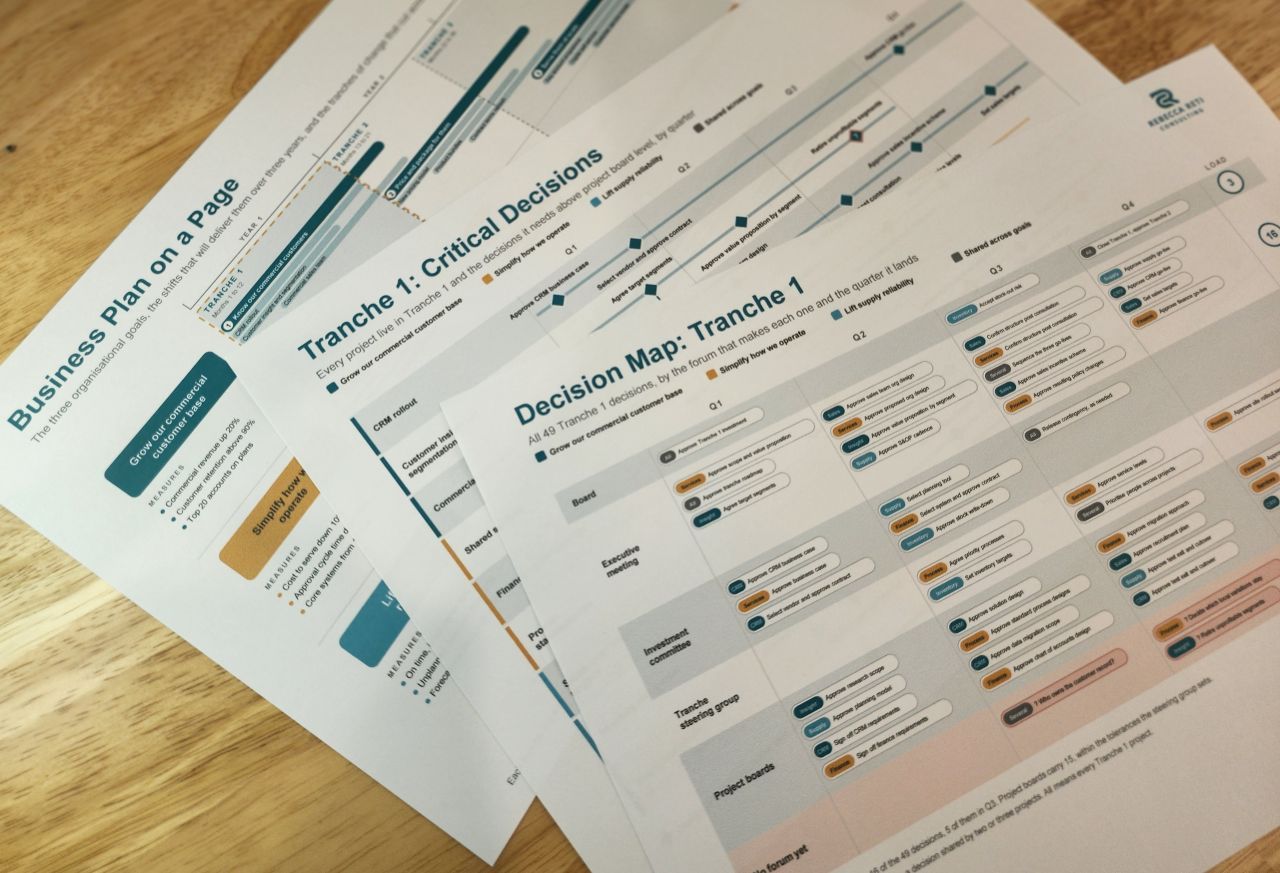
When I build an integrated business plan with a leadership team, one of the first things we do is map the critical decisions. For each one, we answer four questions:
- What is the decision? Write it as a choice. "Approve go-live for the new billing system" beats "billing".
- When does it land? A date or a trigger, tied to the plan.
- Where does it sit? One role or one forum. A committee of eight is a waiting room.
- Who has input, and who needs to know? Keep both lists short.
Here is what a few rows look like:
Two questions to ask once you see the map
Which of these could be pushed further down? Test each decision against two things. Does the person closer to the work hold the information needed? Is the downside recoverable if they get it wrong? Two yeses, and the decision moves down. Write the boundary next to it, such as a spend limit or an agreed scope, so the person knows where their call ends.
Where will our governance slow the rest of them down? Line the decision dates up against your meeting calendar. A decision due in March that needs a board paper, with the board meeting in February and May, has a two-month delay built in. You have found the roadblock before you hit it.
Answer both questions before delivery starts, and you design the delays out instead of discovering them in week nine.
Make "this decision is stuck" safe to say
Clarity about who decides solves half the problem. The other half is whether a team leader feels safe telling a GM, in front of peers, that the GM's decision is holding up the work.
Three habits help:
- Add a standing "decisions waiting" item to the leadership meeting, with how many days each one has waited.
- Name the decision, never the person.
- Go first. Ask your team: "Which of my decisions are you waiting on?" Then act on the answer.
The first time a leader does this in the room, the queue gets shorter. Visibly.
Where this fits in Strategy Execution by Design
Decision rights sit within Governance and Accountability, Lever 4 of the Strategy Execution by Design model. The lever covers who owns what, how decisions get made and how progress gets held to account. Read the full lever or see all seven levers.
Frequently asked questions
What is escalation culture? Escalation culture is a pattern where decisions routinely go up the hierarchy for approval, even when people closer to the work have the information to make them. Decisions queue at senior leaders and delivery slows to match.
What are decision rights? Decision rights define who makes a specific decision, who gives input, and who needs to be told. Clear decision rights stop decisions defaulting upward.
How do you reduce escalation without losing control? Move a decision down only when the person closer to the work holds the information and the downside is recoverable. Set a written boundary, such as a spend limit, so control sits in the design instead of in every approval.
What is a critical decision map? A critical decision map lists the decisions your strategy depends on, when each one lands, where it sits and who has input. Leadership teams build it alongside the integrated business plan.
How often should you review your decision map? At every planning cycle, and whenever your structure or strategy changes. Quarterly suits most leadership teams.
When did your leadership team last map where its critical decisions sit? If the honest answer is "never", you are in good company. Most teams haven't. The SEBD Snapshot assessment gives you a flavour of where your execution is slowing down, decisions included.
Take the Snapshot assessment →
Source: McKinsey & Company (2019), Decision making in the age of urgency, McKinsey Global Survey. Quotes from senior leaders interviewed for Reti, R. (2022), Massey University.