Strategy Execution By Design
Most organisations don't fail at strategy.
They fail at execution.
Strategy Execution by Design is the diagnostic that tells you why, and shows you what to do about it.
A research-backed maturity assessment for executive teams who are tired of strategies that stall.
The execution gap is real. And it's expensive.
Every senior leader I work with tells me a version of the same story.
The strategy is clear. The leadership team is committed. The plan looks sound on paper. But twelve months in, momentum has stalled, priorities have drifted, and the gap between what was promised and what's been delivered is growing.
It's not a strategy problem. It's a problem with the systems and conditions of the organisation.
Most organisations are running modern strategies through legacy execution conditions. The governance, the goal systems, the performance frameworks, the cultural norms, the resourcing models. None of it was designed for the strategy now in play.
My research with senior leaders found that strategy execution effectiveness averaged around 55%. Nearly half of strategic energy is wasted. Not because of bad strategy. Not because of bad people. Because the systems and conditions weren't designed for what the strategy demands.
That's the gap SEBD Framework measures.
The Strategy Execution by Design Framework
SEBD is a research-backed execution maturity framework that assesses the conditions an organisation needs to deliver its strategy.
It came out of original research with senior leaders in New Zealand, and it is grounded in two decades of practice with CEOs, boards, and executive teams across Australia, and New Zealand.
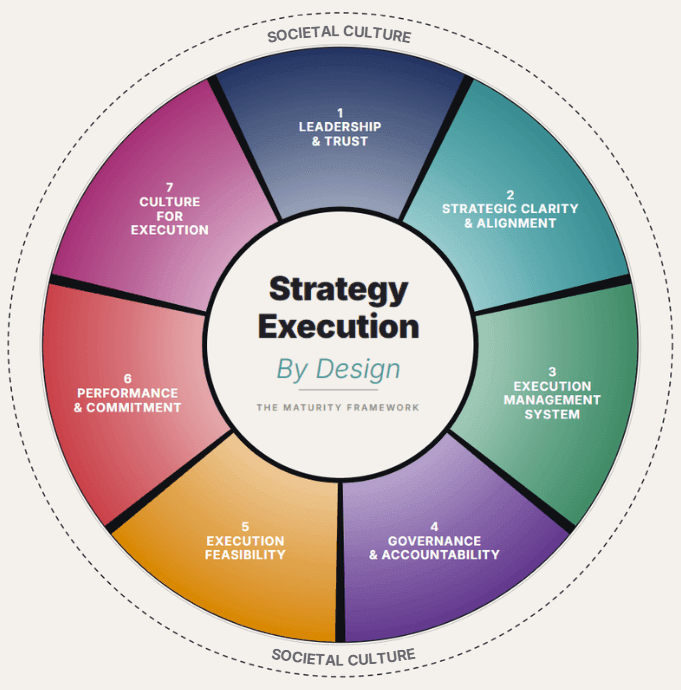
The model evaluates 7 levers, each with 5 elements, measured through 233 specific indicators. Not opinions. Not engagement scores. Structural conditions that either enable or inhibit execution.
And it does something no other execution framework does. It evaluates those systems and conditions within the societal culture the organisation operates in.
Because an execution system designed without understanding the cultural context will fail. Not because people aren't capable. Because the culture doesn't support it without the right interventions.
The cultural overlay applies anywhere the GLOBE Project has data, currently 62 countries.

The 7 Levers of Execution Maturity
Execution doesn't break in one place. It breaks across a system.

1. Leadership & Trust
Whether the leadership team operates as a genuine collective, provides clear direction, learns and adapts, trusts each other enough to be honest, and builds the relationships that move work across boundaries.

2. Strategic Clarity & Alignment
Whether the strategy is clear and focused, the operating model supports it, the translation to action has happened, people can articulate it in their own words, and the organisation adjusts when conditions change.

3. Execution Mgmt. System
The operating system for execution. Integrated visibility across all work, goals that drive alignment, value realisation, healthy information flow, and a learning architecture that prevents repeating the same mistakes.

4. Governance & Accountability
Whether governance is deliberately designed for the current strategy, decision rights are clear, leaders have genuine visibility into execution reality, cross-functional coordination works, and escalation is healthy.

5. Execution Feasibility
Whether the organisation has the resources, capacity, and infrastructure to deliver. Capital allocation, workforce capacity after BAU, change absorption, delivery capability, and the systems that make feasibility visible.

6. Performance & Commitment
Purpose, psychological safety, shared ownership, performance recognition, and collective commitment. These are the people conditions that enable discretionary effort. These are the people conditions that enable discretionary effort.

7. Culture for Execution
Whether the culture is aligned to what strategy needs, norms support follow-through, constructive challenge is expected and enabled, the right behaviours are reinforced, and culture is consistent across the organisation.
Why execution fails differently in every country
Most execution frameworks were built in North America. They assume people are comfortable with direct challenge, that hierarchy gets questioned, and that individual assertiveness is valued.
That is not how every culture works.
The SEBD Framework integrates the GLOBE Project's research, the most comprehensive study of societal culture ever conducted. Nine dimensions, each mapped to the specific execution conditions it affects. Here is what each one shapes.
The nine cultural dimensions
1. Assertiveness: Whether difficult truths surface or get filtered on the way up. When challenge does not come naturally, leaders end up deciding on half the picture.
2. Power Distance: Whether decisions are distributed or wait for the top. It shapes how far authority genuinely travels, and how honest people are with those who hold it.
3. Institutional Collectivism: Whether people work across boundaries or protect their function. When rewards recognise individuals and strategy demands collective action, behaviour follows the rewards.
4. In-Group Collectivism: Where loyalty sits. Strong team cohesion is an asset, until commitment to the team outweighs commitment to the enterprise.
5. Future Orientation: How far ahead people plan, invest, and delay gratification. It decides whether planning is genuinely strategic or tactical work in a strategic costume.
6. Performance Orientation: Whether high standards are encouraged and rewarded. It shapes whether follow-through gets recognised, and whether missed commitments carry consequences.
7. Uncertainty Avoidance: How much people rely on rules and process to reduce unpredictability. It shapes appetite for risk, pace of decisions, and how much structure execution needs.
8. Humane Orientation: Whether fairness and care are rewarded. It shapes how accountability conversations are held, and whether they happen at all.
9. Gender Egalitarianism: How much gender role differences are minimised. It shapes who gets heard, who gets sponsored, and who is given genuine authority to act.
Each dimension is measured on two scales: how people actually behave, and what they believe should be true. The gap between them is where the insight sits. It tells you whether an intervention needs to compensate for the culture, unlock it, or simply align with it.
That is why the same finding calls for a different response in different countries. The conditions are universal. The way you build them is not.
How the diagnostic works
A structured, time-bound diagnostic that gives you a clear picture of where execution is strong and where it's at risk.
Step 1: Calibration session
We start with a working session with your leadership team. This is not a briefing. It is a structured conversation that surfaces how the team sees the organisation's execution conditions, where perspectives differ, and what the cultural context means for your environment. It also sets the baseline for the assessment.
Step 2: Three perspectives in parallel
Three perspectives are captured in parallel. Your leadership team assesses execution maturity across 145 indicators. Selected peer leaders provide a cross-functional lens on 33 indicators. And staff across the organisation respond to 131 experience statements. The gap between what leaders believe and what staff experience is often the most powerful finding.
Step 3: Consultant evidence review
I review the documents, governance structures, and systems that underpin execution. Where it adds value, I observe leadership and governance forums in action. This gives the assessment an evidence base beyond perception.
Step 4: Cultural overlay
Findings are mapped against the GLOBE Project's cultural dimensions for your country. This reveals where societal culture explains the scores, where headwinds will make improvement harder, and what type of intervention will actually work in your context.
Step 5: Findings session
A facilitated working session with your leadership team. Not a presentation. A structured conversation where the data speaks, perspectives are explored, and the team engages with what the assessment reveals. The cultural context reframes challenges from "what's wrong with us" to "what do we design for."
Step 6: Prioritised action plan
A roadmap in 90-day horizons with culturally informed interventions. Each action specifies what it is, who owns it, and what success looks like. Structural actions marked COMPENSATE are permanent infrastructure, not temporary programmes.
Why the SEBD Framework is different
1. It's built from research, not theory
Original eMBA research with senior leaders across New Zealand using Q-sort forced prioritisation. Every lever was tested against what breaks execution in practice.
2. Assesses the system, not the people
Most diagnostics tell you what's wrong with your team. SEBD tells you what's wrong with the systems and conditions your team operates within. Commitment is a system output, not a people problem.
3. Designed for execution, not for strategy
Most strategy frameworks help you decide what to do. SEBD tells you whether the organisation can actually deliver it.
4. Culturally grounded, not culturally blind
Every other execution framework assumes one cultural context. SEBD maps execution conditions against societal culture. The recommendations are designed for your culture, not borrowed from someone else's.
5. A maturity model, not a heatmap
A 5-level maturity scale on every indicator with specific descriptions of what each level looks like. You know exactly what better looks like and how far you are from it.
Get the full SEBD Framework overview
A 23-page walkthrough of the research, the seven levers, the cultural dimension, and how a diagnostic runs.
Ready to see what's really going on?
If your strategy is sound but execution keeps stalling, the answer isn't another planning cycle. It's understanding what conditions are in place and what's missing.

SEBD gives you that picture.

Across 7 levers, 35 elements, and 233 indicators. Triangulated across leadership, peers, staff, and independent evidence. Set within your cultural context.